Skip to Content
  • Bain.com Home
  • Subscribe
  • Connect
  • About NPS
    Main menu

    About NPS

    • Understanding the System
    • The History
    • The Benefits
    • Three Types of Scores
    • Companies Using NPS
    • NPS in B2B
    Recommended reading: A collection of our best thinking
    Important Concepts
    • Measuring Your Score
    • Employee NPS
    • NPS and Growth
    • Predictive NPS
  • Resources
    Main menu

    Resources

    • NPS Prism® Benchmarks
    • NPS Loyalty Forum
    • Additional Vendors
    • Recommended Videos
    • CX Standards
    Listen to The Customer Confidential Podcast
    Interactive tool
    • Customer Love Quiz
  • Book
  • Insights
  • Contact
    Main menu

    Contact

    • Workshops and Speaking
    • Trademarks and Licenses
  • Bain.com Home
  • Subscribe
  • Connect
  • About NPS
    • About NPS

      • Understanding the System
      • The History
      • The Benefits
      • Three Types of Scores
      • Companies Using NPS
      • NPS in B2B
      Recommended reading: A collection of our best thinking
      Important Concepts
      • Measuring Your Score
      • Employee NPS
      • NPS and Growth
      • Predictive NPS
  • Resources
    • Resources

      • NPS Prism® Benchmarks
      • NPS Loyalty Forum
      • Additional Vendors
      • Recommended Videos
      • CX Standards
      Listen to The Customer Confidential Podcast
      Interactive tool
      • Customer Love Quiz
  • Book
  • Insights
  • Contact
    • Contact Us

      • Workshops and Speaking
      • Trademarks and Licenses
    Popular Searches
    • Net Promoter Score
    • Employee NPS
    • Benchmarks
    Your Previous Searches
      Recently Visited Pages

      Content added to Red Folder

      Red Folder (0)

      Removed from Red Folder

      Red Folder (0)

      The Customer Confidential Podcast

      In Business, Good Guys and Gals Really Do Finish First

      Just like the nimble insurgents disrupting their markets, incumbents can deliver outsized shareholder returns by treating customers right—and investing in the systems and tools to earn and measure customer-led growth.

      By Rob Markey and Maureen Burns

      Podcast

      In Business, Good Guys and Gals Really Do Finish First
      en

      You can listen to this episode and others on Apple Podcasts, Spotify, Stitcher, or your podcast provider of choice.

      With their often-streamlined operating models, digital native insurgents have placed many industries under attack. Such models grant them clear visibility into customer happiness, allowing them to easily identify opportunities to improve customer relationships.

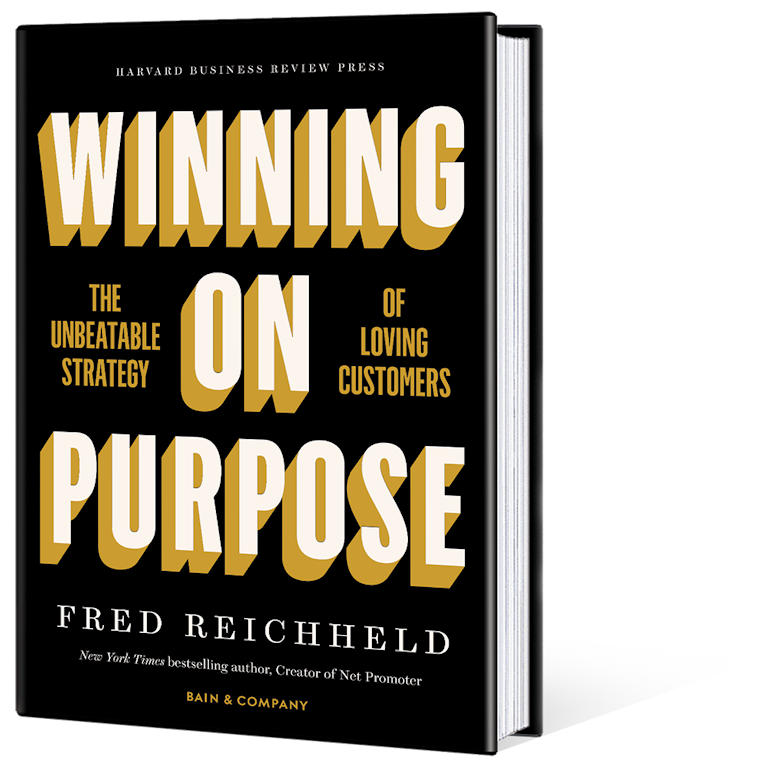
      Incumbents, however, have often been weighed down by operational hurdles and siloed management models, resulting in middling NPS for years. But many leaders see insurgents’ strategies and methods out of reach for them. Maureen Burns, a Bain Partner and coauthor of the new book Winning on Purpose: The Unbeatable Strategy of Loving Customers, says they shouldn’t despair.

      Order the Bain Book

      Winning on Purpose: The Unbeatable Strategy of Loving Customers

      This new book by Fred Reichheld, Darci Darnell, and Maureen Burns demonstrates that great leaders embrace a higher purpose to win, and Net Promoter® shines as their guiding star.

      “I like to say nice guys and gals finished first, and it’s really true,” she says. “And it’s exciting for me to be able to tell that to executives and give them the confidence that they can deliver for customers like insurgent brands do.”

      The key, says Maureen, is to learn from insurgent brands and, over time, use similar methods to transform your business until it truly centers around customer satisfaction. The result? Happier customers and satisfied shareholders.

      “There is no conflict between doing good for customers and employees and doing amazingly well for shareholders,” Maureen explains. “I think that many executives see this false trade-off between making the decisions that are going to help them deliver for customers and employees and drive shareholder return.”

      The road to such a customer-centered strategy is not an easy one. Maureen says it relies on a company’s willingness to invest in and undergo a significant transformation, often reconstructing their data collection and sharing methods and reorienting customer-centered accounting.

      But companies that do invest, according to Maureen, set themselves up for long-term, sustainable success with both customers and shareholders.

      “Always putting the customer first, inherently first, like really giving them more value and making their lives better, is actually the most sustainable way to drive out performance,” she says.

      In this episode, the second in a series with the authors of Winning on Purpose, Maureen and I discuss the indisputable value of a truly customer-centric strategy, why it is so hard for big companies to actually deliver, and how those hurdles can be overcome.

      Learn more about Winning on Purpose and purchase a copy here.

      In the excerpt below, Maureen and I discuss the benefits of the earned growth model of accounting and how companies can use it to gauge customer happiness.

      Maureen Burns: One of the things that we’ve talked about in the book is this concept of earned growth. So, looking at how much of your growth is coming from existing customers, buying more and referring vs. bought through marketing. So simple concepts like that I think are important. Because if you think about it, it is really retention, share of wallet referrals, and paid marketing.

      So really, the components of customer acquisition costs. So, if you’re looking at these things, it’s a really good way to kind of understand the health of your customer base and the health of your company, ultimately, because really that is what drives growth over the long term.

      Rob Markey: As I’ve tried to get my head around this concept of earned growth and not just the high-level version of “It’s important to earn your growth,” which seems to me the healthiest way to grow, but specifically the idea of creating an earned growth rate metric as a way of gauging how the company is doing.

      I wonder how you would react to my characterization of it as a measure for quality of earnings or quality of growth.

      Maureen Burns: Absolutely. It absolutely is. Because if you think about what we’re saying, and you were the one in one of our conversations that said, “This is really an overarching philosophy of how you run a business,” which is: I am going to earn my growth vs. this constant treadmill of paid marketing to acquire more and more.

      I do think it is a very good indicator of the health and quality of your earnings. We also know from all the micro level economics we did at different companies that these earned customers end up having better profiles over time. Right. They end up buying more. They end up having lower cost to serve. They end up referring more. So, we’re kind of calling it the promoter multiplier, and it’s kind of got an exponential effect. When this is your model you are driving growth in a different way than companies that are buying growth. And we believe that this is really the underlying reason that those NPS leaders that you identified have outperformed the market as handily as they have.

      And so, it all comes together in a way that says if I can get this mindset and I can really understand that there’s a different way of doing business, that’s how you drive really sustained outperformance.


      Listen

      Want to hear more from today's loyalty leaders?

      Explore more episodes of The Customer Confidential Podcast.

      Authors
      • Headshot of Rob Markey
        Rob Markey
        Advisory Partner, Boston
      • Headshot of Maureen Burns
        Maureen Burns
        Partner, Boston
      Contact us
      The Customer Confidential Podcast
      Healthcare’s Empathy Factor: Capturing Real Patient Experiences

      Dr. Adrienne Boissy, a neurologist and the chief medical officer at Qualtrics, advocates for a comprehensive patient-centric approach to measuring the healthcare experience.

      More
      The Customer Confidential Podcast
      Nourishing Business Diversity: A Look into METRO’s Customer-Centric Evolution

      Peter Gries of Germany-based food wholesaler METRO shares how the company has transformed its relationship with customers.

      More
      The Customer Confidential Podcast
      The Transformation of Media Consumption and Loyalty in the Digital Era

      Nielsen CEO David Kenny emphasizes the key role of consumer trust amid changing media consumption trends.

      More
      The Customer Confidential Podcast
      Agile, Digital, and Human: Eliminating Bad Customer Experiences

      Joe Wheeler from CX/Digital shares his journey navigating the digital-first route to customer delight and earned growth.

      More
      The Customer Confidential Podcast
      No Strings Attached: Genuine Referrals as the Secret to Earned Growth

      Mention Me's Andy Cockburn discusses the value of unbiased referrals and social psychology’s role in motivating them.

      More
      grudnia 16, 2021
      Tags
      • Net Promoter System®
      • The Customer Confidential Podcast

      Want to continue the conversation?

      We offer unparalleled analytic and organizational tools for the Net Promoter System. Together, we can create an enduring customer-centric culture.

      Get the latest on loyalty in your inbox. Our quarterly Loyalty Insights newsletter offers our best thinking and tips on running the Net Promoter System.

      *I have read the Privacy Policy and agree to its terms.

      Please read and agree to the Privacy Policy.
      Bain & Company
      Contact us Connect Subscribe Terms of use Privacy Environmental Policy Sustainable Procurement Policy Sitemap

      Net Promoter®, NPS®, NPS Prism®, Net Promoter System®, and the NPS-related emoticons are registered trademarks of Bain & Company, Inc., NICE Systems, Inc., and Fred Reichheld. Net Promoter Score℠ is a service mark of Bain & Company, Inc., NICE Systems, Inc., and Fred Reichheld.