


This article originally appeared on LinkedIn.
One of the definitive reference works on great leadership and how leaders build great companies is the perennial bestseller Good to Great by Jim Collins. In that 300-plus-page book, which indeed contains many important insights, the word “customer” does not appear until page 24. In total, the book mentions “customer” only 56 times. Evidently, “customer” does not play a vital role in this traditional view of greatness. Perhaps that is why Collins’s 11 exemplar companies (on which the book was based) plunged so quickly into mediocrity. Their total shareholder return was 60% below the North American median in the decade following publication, according to an analysis we did my latest book, Winning on Purpose: The Unbeatable Strategy of Loving Customers, written with Darci Darnell and Maureen Burns.
In stark contrast, Winning on Purpose mentions “customer” on the cover and 1,033 more times throughout its 225 pages. The word “love” appears 203 times. You will also see that the Net Promoter Score leaders we used as exemplars in my previous book, The Ultimate Question 2.0, written with Rob Markey, delivered total shareholder returns more than five times the market median in the decade following its publication.
You might conclude that at least based on word count, we believe the customer is about 20 times more important than traditional business thinkers do. You might also conclude that based on returns to investors, “loving customers” plays a central role in true greatness. To me, great companies are those that make the world better and are great places to work. Outstanding financials are one outcome of that greatness. Enriching customer lives precedes and ignites that greatness.
In the final chapter of Winning on Purpose, we propose this radical manifesto.
"Great companies help people lead great lives—they are a force for good. Great leaders build and sustain such communities. They inspire team members to forge lives of meaning and purpose through service to others—service not merely satisfactory, but so thoughtful, creative, and caring that it delights customers and enriches their lives.
The building blocks of great communities are relationships, founded on the principle treat others the way you would want a loved one to be treated or, in its purest form, love thy neighbor as thyself. This Golden Rule establishes the highest standard of excellence in human affairs.
When companies create policies, procedures, cultures, and rules of membership to reinforce accountability to Golden Rule standards—across all community members—they provide the foundation for building relationships worthy of loyalty.
Companies earn loyalty from customers by treating them with loving care. That loyalty is apparent when customers come back for more, recruit their friends, and provide precious feedback on how to build an even better relationship. In this way, love begets loyalty, which powers sustainable, profitable growth, and illuminates the path to greatness for the organization, its teams, and for each individual team member. This system underpins the financial prosperity enjoyed by communities that hew most closely to Golden Rule standards.
Therefore, the primary mission of every organization striving for greatness should be to build a community whose primary purpose is to sustainably enrich the lives of customers and where all members are treated in accordance with (and are held accountable to) the Golden Rule.
This mission demands that leaders:
- Embrace an unbeatable purpose. Leaders clarify that enriching customers’ lives stands foremost as the organization’s primary purpose. They teach team members how this philosophical North Star should guide priorities, decisions, and trade-offs, thus illuminating the path to personal and organizational success.
- Lead with love. The primary duty of leaders is to care for their people. They must inspire teams to embrace this customer purpose, and enable their success by allocating sufficient time, education, and resources to accomplish this mission. Leaders must be role models who practice, preach, and teach Golden Rule principles and values that systematically reinforce a loving culture through symbols, words, and deeds.
- Inspire teams. Team members must feel energized by this mission to enrich customer lives and be empowered to root out policies, procedures, and behaviors that are contrary to the Golden Rule, confident that they will be supported in their efforts to always do the right thing.
- Unleash NPS-caliber feedback flows. Systems and technology support timely and reliable feedback from customers and colleagues, augmenting surveys by incorporating the entire signal field of purchase behavior, usage, online commentary, ratings, and customer service interactions. Constant innovation is required for collecting, curating, and distributing the right feedback in a world that has grown tired of surveys—a world overwhelmed by data and increasingly reliant on digital bots, data science, and algorithms.
- Nurture relentless learning. Leaders must create a culture of loving feedback, a prerequisite for honoring the Golden Rule. This includes training on the most effective techniques for giving, gathering, and receiving feedback and providing a safe space for processing it.
- Quantify earned growth economics. Leaders and employees must understand and utilize customer-based accounting metrics (provided and endorsed by the CFO) to evaluate trade-offs and investment decisions.
- Regularly redefine the remarkable. Leaders and teams must humbly recognize how much progress and innovation are required to make sure each customer feels loved. Leaders strive continuously to invent new ways to delight customers with remarkable products and experiences. Each individual, team, and group feels empowered and responsible for creating such remarkable experiences that customers come back for more and refer their friends."
Yes, this customer-centered view of the business world is indeed radical. Only 10% of business leaders now believe that the primary purpose of their business should be to enrich the lives of customers. But the evidence is increasingly clear. Strive for greatness without loving customers at your own peril. Our data shows that only way to reliably and sustainably deliver outstanding value to shareholders is to become the greatest at loving your customers.
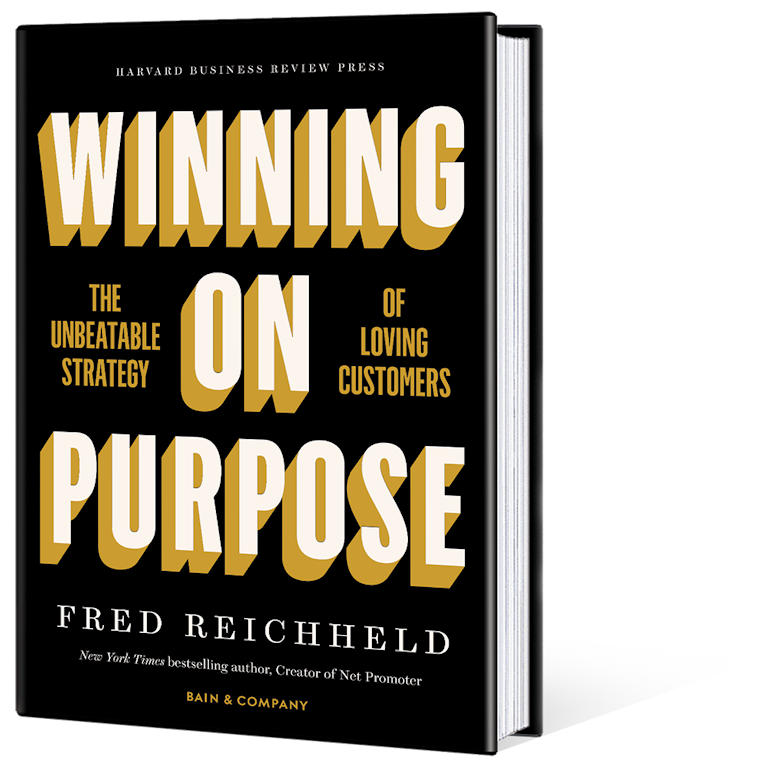
Winning on Purpose: The Unbeatable Strategy of Loving Customers
This new book by Fred Reichheld, Darci Darnell, and Maureen Burns demonstrates that great leaders embrace a higher purpose to win, and Net Promoter® shines as their guiding star.
August 16, 2022