


This article originally appeared on LinkedIn.
I recently had an interesting conversation with Peter Crosby for the podcast Unpacking the Digital Shelf.
When Peter asked about the challenges of operating in what seems like a time of chronic crisis, from inflation to supply chain issues, upstart competition, and technology’s ongoing disruptions, my mind turned, naturally, to customer capitalism and purpose. To focus on delighting customers truly is the answer to all those challenges, and as I told Peter, that’s the reason why our book is called Winning on Purpose.
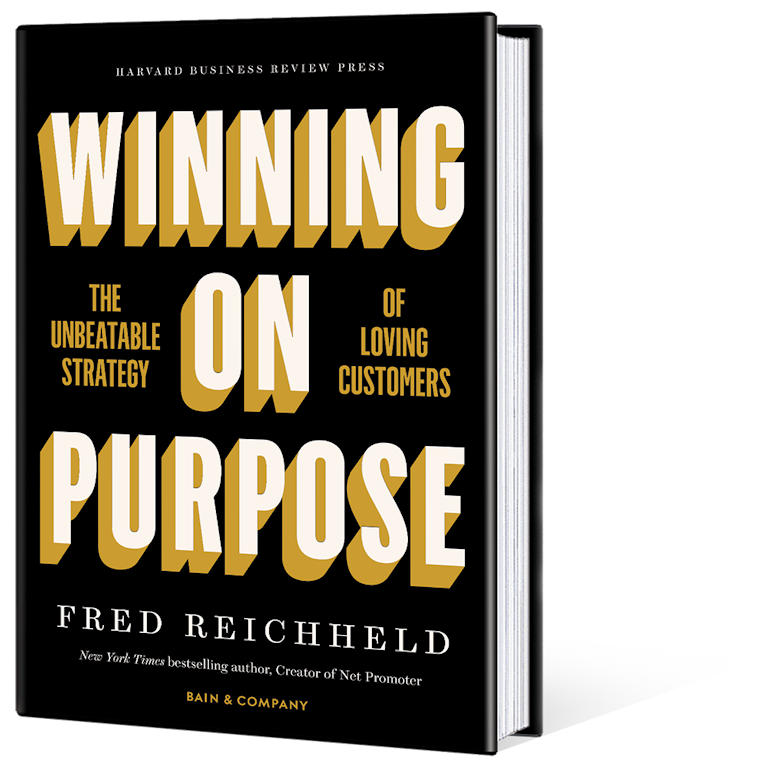
Winning on Purpose: The Unbeatable Strategy of Loving Customers
This new book by Fred Reichheld, Darci Darnell, and Maureen Burns demonstrates that great leaders embrace a higher purpose to win, and Net Promoter® shines as their guiding star.
“Without the right purpose you have no chance of enduring success. Ninety percent of businesses today have embraced a purpose that is guaranteed to fail because it’s about something other than putting customers’ interests first. I was shocked. When we asked business leaders around the world what is the primary purpose your organization exists, only 10% said it’s to make our customers’ lives better. When you are in a company where the leadership purpose is off center [like that], you either have to get it on center or go work somewhere else, because it’s not going to lead to victory.”
The problem, I explained, is that many executives don’t realize that their organizations are not customer focused.
“It’s so commonsensical. Most people who will read this book will say we must already be doing this. But they’re not. Ask your coworkers, ask the people on the teams that work for you to read the book, what they see that’s different, and what you’d need to change inside the company to actually live these principles. I think you’ll get some surprises.”
Of course, having a proper purpose isn’t enough. You have to also be persistent. I told Peter about our koi pond at our Cape Cod home.
“I like koi because I think persistence is so vital in everything we do. Koi evolved from fish living in the mouths of freshwater rivers in Asia. The koi had to swim against the current of that river its entire life or else it would be washed out to the saltwater sea and to its death. And so koi is the symbol of persistence in Chinese art. I think it’s a valuable metaphor because the current that exists in every business is created by the need for profits and revenue and financial metrics. You’re pounded with those every day, day in day out. That river flow is powerful. And so if you want to fight against that and not be washed out to your death you have to instill in teams the ability to 24/7 have discussions about principles—delighting customers, progress on those fronts, golden rule principles of enriching lives.”
You can listen to our full conversation here or subscribe wherever you get your podcasts.
Recommended reading
We know bad profits are immoral and antithetical to the interests of both customers and long-term investors, but a recent Supreme Court decision finds that they are also unconstitutional. In an article in The Boston Globe, “Hidden Terms, High Cancellation Fees, Complex Disclaimers Should Be Forbidden,” Harvard Law School professor and author Cass Sunstein describes the case, which had been brought by employees of Northwestern University. The employees claimed the university had violated its fiduciary obligation, particularly its “duty of prudence,” by offering a dizzying number of retirement plan options (more than 400), that often included complex disclosures and hidden fees. Some of the options were quite bad. Northwestern’s defense was that the employees had choice; there was no obligation to choose a bad plan.
The court ruled that free choice isn’t enough. Those choices must be laid out in a way that is helpful and clear, especially to the most vulnerable. “It is time to recognize a new right,” Sunstein argues, “the right not to be manipulated.”
Good riddance to caveat emptor!
Customer love highlight
My electric shaver stopped working after nine months. I hadn’t kept any receipts or warranty information, but I recalled buying it at Costco. So, I took it back to my Costco warehouse, where the customer service clerk scanned the product number on the bottom of the device and credited back what I had paid, including tax. I asked what the time limit was for returns like this, and she said: “Well, we have time limits for cell phones and some technology items like TVs because some customers were abusing our generous system, but for items like your shaver, there really is no set limit. If the customer is not happy, we trust their judgment and process the return.”
I think this is a wonderful example of the philosophy that companies don’t deserve to earn any profit until the customer is happy.
The Unbeatable Strategy That Too Many Leaders Miss
Bain Partner Priscilla Dell'Orto is joined by Fred Reichheld and Darci Darnell, coauthors of Winning on Purpose, to discuss how businesses can grow loyalty.
April 28, 2022