The Customer Confidential Podcast
Agile Is Not Just a Method, It’s a Mindset
The surest sign that Agile is working, says Bain’s Darrell Rigby, comes when an entire organization demonstrates an obsession with customer satisfaction.


The Customer Confidential Podcast
The surest sign that Agile is working, says Bain’s Darrell Rigby, comes when an entire organization demonstrates an obsession with customer satisfaction.

Like Six Sigma, Quality Circles and even Net Promoter, Agile’s meteoric rise in popularity has put it at risk of becoming a caricature of itself. There’s just enough truth in the worst caricatures of Agile, says Darrell Rigby, to make them seem credible: Weird language. Whiteboards covered with sticky notes. Teams that claim to know more about what customers want than longtime sales or customer-care experts.
Darrell is a fellow Bain partner and the coauthor of a new book, Doing Agile Right. He leads Bain’s Agile practice, and the first question I had for him was, Why that title?
His answer: He’s seen a lot of Agile done wrong.
“I believe passionately that Agile is the future,” Darrell told me. “I do believe that this is the way that companies will be run going forward. My biggest fear is that there’s a lot of Agile that’s being done wrong. If we don’t fix that, then Agile is likely to turn into the next management fad.”
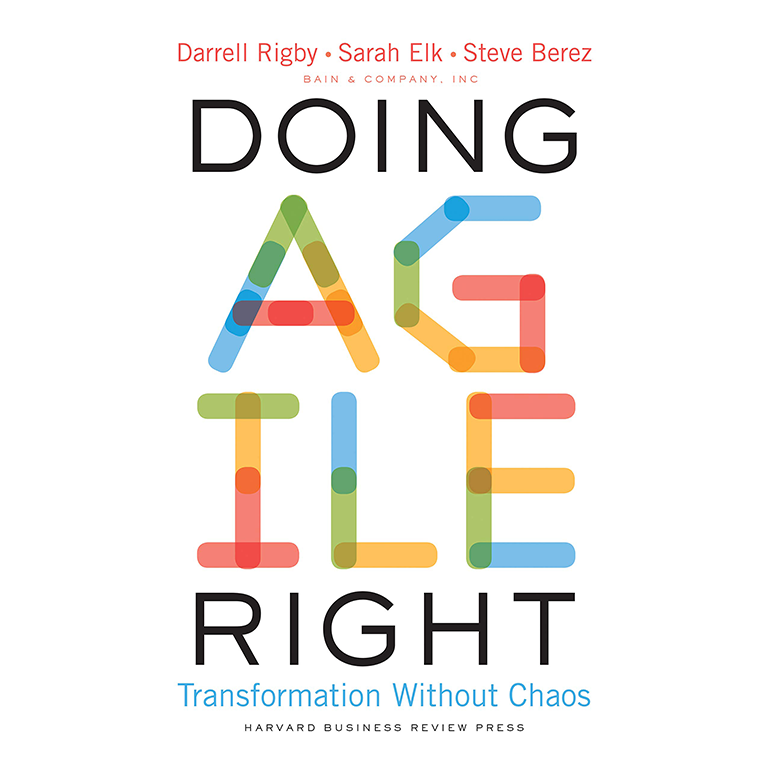
Agile has the power to transform work—but only if it's implemented the right way.
Past podcast episodes have explored how Agile has accelerated and improved customer experience for companies like UPS Capital, UniCredit, USAA and Vanguard. So I asked Darrell to join me to help define how Agile can have such dramatic results when it’s done right—but also how it can go wrong, and what common missteps companies can avoid.
If Agile is working right, Darrell says, it “accelerates successful adaptation through deep customer collaboration and adaptive testing and learning.” Agile is not just telling people to do their jobs faster than before. Nor is it simply dividing everyone in the organization into squads, or worse, laying off large chunks of the organization. The result of those misguided approaches? “A lot of ‘agile’ teams up and running, but the organization isn’t really more agile.”
“The surest sign that Agile is working,” he says, “is when you see an entire organization becoming obsessed with customer satisfaction. And everybody believes that their work is serving a customer.” That’s true even if the customer is an internal one; every work activity has a customer. By contrast, “the surest sign that Agile is being done wrong is that the people are using Agile language, but there isn’t a noticeable culture of concern for customers and employees.”
You can listen to my conversation with Darrell on Apple Podcasts, Spotify, Stitcher or your podcast provider of choice, or through the audio player below.
In the following excerpt, Darrell talks about what it takes to make Agile stick.
Darrell Rigby: How do we actually become an Agile enterprise? One that balances the business system, so that it runs efficiently, it adapts quickly, and it harmonizes innovation with operations so that those capabilities, those activities, actually work well together?
There are a lot of tools that you can use to do that . . . to clarify and unify the purpose and values. Because when you have alignment about the purpose and values inside an organization, it’s much easier to delegate authority and responsibility to various parts of the organization. You may need to clarify your strategy. Almost always you have to change the leadership and the culture in the organization. You probably will change your management systems—planning, budgeting, reviewing—to do those things more frequently.
Yes, you may change structure and accountabilities, [but] it’s not typically one of the first things you would do. We don’t typically recommend starting like a lot of people do, like a number of our competitors do, by saying, “You can’t do Agile until you restructure, until you reorganize the entire company.”
And so, often, we will say, “Let’s try it in the current structure” or “Let’s make sure that we’ve got a good business definition. We don’t need to tear apart the structure and pull everybody out. Let’s figure out how to use Agile teams within the business units you’ve got. Let’s see if we can make it work with the current structure. If not, that’s fine. We can change it over time.” But why create all of that chaos in the organization, when data suggests that organizations are plenty capable of becoming more agile without the chaos?
Rob Markey: I dunno, Darrell, when I listen to you talk about it that way, I just think of my clients who are super impatient. And I can totally imagine them saying, “Oh my god! You cannot be serious. I have to experiment my way into this? It’s going to take a really long time?” Leadership teams don’t like to do that.
Darrell Rigby: Yeah, and the truth is we can go as fast as the organization is capable of going. We’ve stood up hundreds of Agile teams in a short period of time. And we’ve changed their management reporting systems and budgeting processes. But too many of these executives feel like people who have gone on crash diets, to me anyway. That “Oh, I don’t have time. I’ve got a high school reunion coming up. I’ve got to look great for the reunion.” And most of those people end up pursuing fads and gaining all of the weight, plus more, back the minute they run into problems.
So, personally, I’d rather work with somebody that is serious about doing Agile right, as opposed to somebody that is looking for a fad to fix it quickly and yet, when you go back three or four years later, you say, “Nothing really changed.”
A significant part of this work is change management work. Behavioral change work that makes it stick. I’ve seen people that try to go at it in the fad method, and it just doesn’t work.
Net Promoter®, NPS®, NPS Prism®, and the NPS-related emoticons are registered trademarks, and Net Promoter Score℠, NPSx℠, and Net Promoter System℠ are service marks of Bain & Company, Inc., NICE Systems, Inc., and Fred Reichheld.

Explore more episodes of The Customer Confidential Podcast.