




|
|
This article originally appeared on LinkedIn. A few years before Nate Henderson founded BILT in 2015, he read my book The Ultimate Question, which lays out how companies can employ the Net Promoter System to create communities of passionate advocates. The book resonated with Nate so profoundly that he focused his new company’s mission on making promoters of the brands and companies it partnered with, using NPS principles. BILT, where I now sit on the board of directors, is a software-as-a-service platform that has reinvented customers’ post-purchase experience. Via its app, it offers 3D interactive instructions that help both pros and do-it-yourselfers assemble, install, and set up their purchases, with guides for everything from Weber grills to ceiling fans and furniture. Proprietary analytics in the BILT platform help brands better understand their customers, capture ratings and reviews, identify stumbling blocks in the instructions, and suggest ways product design can be improved. The platform also captures SKU-level NPS (how likely a customer would be to recommend the product to a friend) and the primary reason for that score. Two of its customers are the US Air Force and Navy, which use BILT instructions to help maintain equipment. Henderson says the company’s instructions can improve a brand’s NPS by up to 20% over traditional, paper instructions. BILT itself reports an end-user NPS of 86, a truly astounding number. Henderson credits the company’s success to his team’s devotion to these guiding principles, as he explained to my colleague Rob Markey on a recent episode of the Net Promoter System podcast. Because the Net Promoter System is core to BILT’s customer-centric culture, Henderson asks every job candidate to read our latest book, Winning on Purpose, and he recently asked the entire company to do the same. Small, interdepartmental groups met for 30 minutes every other week to discuss each chapter. Different members led each group discussion based on a study guide the company created (see an abridged version of that below), but participants often branched off into different aspects or, critically, how to apply the principles to real challenges the company faced. On the weeks when the small groups did not meet, the entire team convened virtually and in-person for discussion. Over time, they covered a 40-foot whiteboard wall with principle-based solutions, client-specific applications, passages from Winning on Purpose they found important to the business, and key questions it raised for each department. The company has even made a video about its book club process. Since I was curious about the book club experience, BILT allowed me to put a series of questions to eight participants. It quickly became clear that the opportunity to connect with colleagues from different departments was one aspect employees found particularly valuable. Liz Cordes, who works as an account director of brand support for marketing, described how meeting and talking with coworkers from other departments helped her understand their challenges and how she could adjust her own work to make theirs easier. Garrett Juergens, a director of brand support for enterprise sales, shared that sentiment. “I always read with the lens of my own responsibilities in mind (whether that be work or personal),” he said. “It’s very eye-opening and beneficial to hear from others. I’m always amazed at what I can learn from my colleagues that I would have otherwise never learned myself.” Matt Ohnesorge, a senior instruction designer, remarked on the way “the broader ideas in the book create a language we can all use together in the office.” And that lingua franca helps keep everyone working toward common, concrete goals, according to Stephanie Raptis, lead instruction designer: “It’s a lot harder to go back to bad habits.” “Rejuvenating” and “reenergizing” is how Jenny Tsao, VP of demand marketing and sales, described the book study. For Tasha Siebach, an account director of brand support for marketing, the most compelling concept in the book is loving your customer. “If my customer isn’t feeling that love, then something is wrong and I’ve got work to do,” she said. The practical application of concepts one might otherwise read over is an invaluable benefit of reading together. Quinton Butler, a senior instruction designer, noted that BILT has four customers: paying clients, the end user, employees, and prospective clients. “Finding the balance between these four is a constant battle,” said Butler. “One customer could be our paying client who needs what feels like 100 revisions for a deadline due tomorrow, while another customer is the instruction designer who is assigned to four different projects. Brainstorming how to improve the various policies and systems to benefit both parties has been a very engaging and important discussion.” 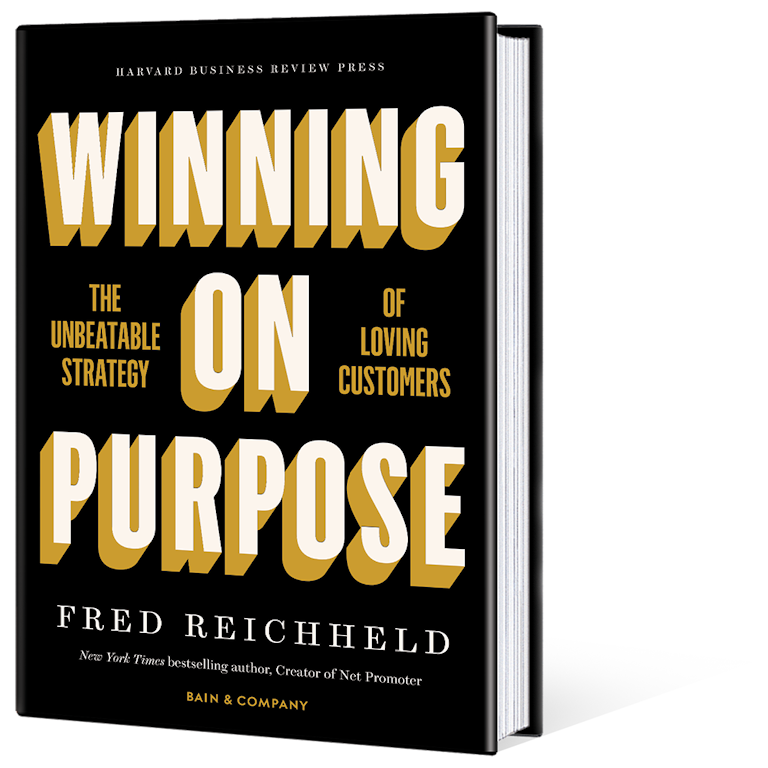
Winning on Purpose: The Unbeatable Strategy of Loving CustomersThis new book by Fred Reichheld, Darci Darnell, and Maureen Burns demonstrates that great leaders embrace a higher purpose to win, and Net Promoter® shines as their guiding star. Butler connected with the book’s focus on being intentional with our limited time. “There is a lot of complacency in the world, creating a very low bar. With our time we are granted the opportunity to be remarkable, and there’s no excuse not to,” he said. “Perhaps the biggest reason for the small book groups is that it gives people time to actually internalize the principles,” says Henderson. “That’s when the mountains truly move. Then a thousand small decisions are being made based on correct principles. No mandate or edict from the top can accomplish that, only willing and intentional commitment can!” A starter discussion guide for Winning on PurposeTo make reading groups most effective, companies can develop a discussion guide for leaders to use. Here is an abridged version of BILT’s guide, which might be a helpful starting point if you decide to hold discussion groups in your organization. Introduction: Know Your PurposeWhat does the book argue is the guiding purpose driving today’s most successful business organizations? Chapter 1: Lead with LoveWhat are the key differences between customer capitalism and shareholder capitalism? Chapter 2: Aim for GreatnessCharles Schwab CEO Walt Bettinger says, “NPS makes it safe for our people to always do the right thing.” Explain. Chapter 3: Love Your CustomersCostco’s hierarchy of responsibility is to (1) the law, (2) their customers, (3) their employees, (4) their suppliers, and (5) their shareholders. Please comment. Chapter 4: Inspire Your TeamsHow can a company turn customer service from a cost center to a profit center? Chapter 5: Respect Your InvestorsHow does putting customers first stoke the loyalty-growth engine and deliver value to investors? Do you think our board members fully appreciate the economics of loyalty? Chapter 6: Honor the Golden RuleThe book argues that to live the Golden Rule, NPS surveys must be augmented with signals. Why this second data stream? Chapter 7: Be RemarkableWhy is satisfaction the wrong target—and how do companies inspire innovation when it comes to CX? Why has e-commerce increased the importance of a “delightful digital welcome”? Chapter 8: Be PersistentWhat are some best-practice systems and rituals we should employ to reinforce company values? Chapter 9: Be HumbleWhat is the Earned Growth metric? What level of Earned Growth should we be targeting? |
octubre 11, 2022