The Customer Confidential Podcast
Ping-Pong Tables Don’t Inspire Employees, Real Autonomy Does
Bain’s Darci Darnell says freeing your employees from common constraints can inspire your team and instill in them a lasting sense of purpose.


The Customer Confidential Podcast
Bain’s Darci Darnell says freeing your employees from common constraints can inspire your team and instill in them a lasting sense of purpose.

You can listen to this episode and others on Apple Podcasts, Spotify, Stitcher, or your podcast provider of choice.
It’s trendy right now for leadership teams to craft lofty statements of purpose. But it’s easier to put words on paper than to incorporate them in the day-to-day business operations. This disconnect often means employees feel detached or uninspired by these mission statements. So, how can leadership teams inspire employees and give them a clear sense of purpose in their roles?
Darci Darnell, a Bain partner and coauthor of the new book Winning on Purpose: The Unbeatable Strategy of Loving Customers, says the organizations that succeed in inspiring their teams with the company’s sense of purpose don’t just craft these mission statements, they help employees understand their role in these missions.
“I think a lot of companies believe that free lunches and ping-pong tables will inspire employees,” Darci says. “But in our mind, showing employees how they can make choices at the front line to better serve the customer and giving them the gift of customer feedback can help employees find satisfaction and purpose in their work.”
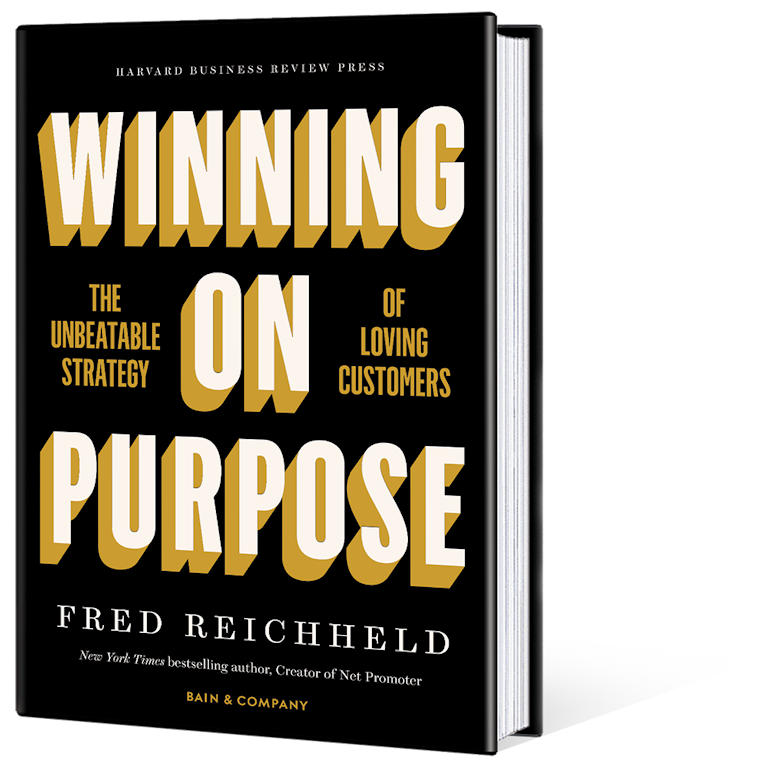
This new book by Fred Reichheld, Darci Darnell, and Maureen Burns demonstrates that great leaders embrace a higher purpose to win, and Net Promoter® shines as their guiding star.
But leadership teams don’t have to just rely on customers to empower their employees. Huddles, Darci notes, are an important step in developing a sense of purpose, since it gives teams the opportunity to learn and grow together.
“There’s a lot of creativity at the front line. I think the collaborative problem solving can really deepen that team affiliation and keep your employees around longer,” Darci says.
Despite this, Darci says many companies continue to create narrow roles for employees by limiting their freedom of interaction with customers and shutting them out from delivering feedback, believing more controls will provide consistent delivery and lead to happy customers and shareholders. But, according to Darci, the investment in freeing your employees from these constraints is worth it.
“Most frontline employees really just want to serve. And if you put that mindset on and say, ‘How do I create enough room for energy and enthusiasm to come through?’ employees will honor your purpose,” she says.

Customer love blooms with purpose-driven leadership. Meet some of the executives inspiring their teams to lead with love.
In this episode, the third in a series with the authors of Winning on Purpose, Darci and I discuss the importance of inspiring employees, and what leadership teams can do to grow and retain their employees’ sense of purpose.
Learn more about Winning on Purpose and order a copy here.
In the excerpt below, Darci and I discuss how T-Mobile transformed its call centers, allowing employees and customers to make meaningful connections.
Rob Markey: I always like to examine why companies think narrowing roles with regulations would be the right thing to do, when we see the opposite, because there are generally very well-intentioned, very thoughtful, very experienced people designing these constraints on employees or these scripted interactions. What are some of the things you see?
Darci Darnell: There are tons of operational metrics that constrain designers of a process at a company. I'll give you a classic one in a call center. If you're running a call center, you really do want to control costs. And the metric that most people use is average handle time (AHT): How much time on average does it take to get a customer through a transaction when they're on the phone?
And a great example of someone who went against conventional wisdom on this is T-Mobile. They did a couple of things in their call centers. First, they reorganized them into micro geographies so that when you call T-Mobile, you'd likely also get a Green Bay Packers fan. Or you'd also get someone who also battened down the hatches in the storm last weekend. So when people talked to them, they had an opportunity to connect before they got to the transaction, and not with a generic “How’s the weather?” but actually a genuine connection that allowed the customer to feel known and like they were talking to someone who would care for them.
I'm sure that took AHT up a notch or two because it just gave those folks in the call center the opportunity to really connect on a human level vs. trying to reduce the interaction to the lowest amount of time required.
Rob Markey: I guess one of the reasons why I can imagine people thinking that it would be smart to limit employees can or should do with customers is that they're trying not only to control average handling time, but they're also trying to ensure consistency of delivery. Why is it not the right thing to do to script those tightly or to ensure that people are all approaching things the same way?
Darci Darnell: I absolutely get the temptation and not least of which because right now, when there's so much turnover on most companies’ front lines, you have to get people up to speed quickly. And you could even argue yourself into thinking, “Well I'm actually helping the employee by giving them confidence to deliver for the customer.”
But what we have found over time is that the freedom to put your own stamp on things and the freedom to serve another human is so core to who we are as human beings that erasing all of that can make these interactions too robotic.

Explore more episodes of The Customer Confidential Podcast.
