


Skip to Content
  • Bain.com Home
  • Subscribe
  • Connect
  • About NPS
    Main menu

    About NPS

    • Understanding the System
    • The History
    • The Benefits
    • Three Types of Scores
    • Companies Using NPS
    • NPS in B2B
    Recommended reading: A collection of our best thinking
    Important Concepts
    • Measuring Your Score
    • Employee NPS
    • NPS and Growth
    • Predictive NPS
  • Resources
    Main menu

    Resources

    • NPS Prism® Benchmarks
    • NPS Loyalty Forum
    • Additional Vendors
    • Recommended Videos
    • CX Standards
    Listen to The Customer Confidential Podcast
    Interactive tool
    • Customer Love Quiz
  • Book
  • Insights
  • Contact
    Main menu

    Contact

    • Workshops and Speaking
    • Trademarks and Licenses
  • Bain.com Home
  • Subscribe
  • Connect
  • About NPS
    • About NPS

      • Understanding the System
      • The History
      • The Benefits
      • Three Types of Scores
      • Companies Using NPS
      • NPS in B2B
      Recommended reading: A collection of our best thinking
      Important Concepts
      • Measuring Your Score
      • Employee NPS
      • NPS and Growth
      • Predictive NPS
  • Resources
    • Resources

      • NPS Prism® Benchmarks
      • NPS Loyalty Forum
      • Additional Vendors
      • Recommended Videos
      • CX Standards
      Listen to The Customer Confidential Podcast
      Interactive tool
      • Customer Love Quiz
  • Book
  • Insights
  • Contact
    • Contact Us

      • Workshops and Speaking
      • Trademarks and Licenses
    Popular Searches
    • Net Promoter Score
    • Employee NPS
    • Benchmarks
    Your Previous Searches
      Recently Visited Pages

      Content added to Red Folder

      Red Folder (0)

      Removed from Red Folder

      Red Folder (0)

      Forbes.com

      The Root Cause of Your Customer's Anger

      The Root Cause of Your Customer's Anger

      If you don’t know the cause of your customers delights and annoyances, you can’t give them more of what they love.

      By Rob Markey and Fred Reichheld

      • min read

      Article

      The Root Cause of Your Customer's Anger
      en

      This article originally appeared on Forbes.com.

      Do you know the root cause of your customers’ delights and annoyances ? It’s a critical question. If you don’t, you can’t give them more of what they love. And you may be tempted to offer the wrong solution to address their concerns.

      Here’s a simple example. Airlines regularly survey flyers asking how likely respondents would be to recommend each of the carriers they use to friends and colleagues. They also probe the reasons for different ratings. Of course, many passengers give certain airlines poor ratings because they believe those airlines perform significantly worse than competitors in on-time performance—more delays, more cancellations, etc. But in many cases, flight data shows that the gap is far less than customers seem to think. What’s really going on?

      A team at one airline that studied customers’ responses noticed that many passengers who were upset about delays and cancellations felt they hadn’t received appropriate compensation. One obvious first response for any airline executives might be: We should certainly improve our on-time performance, and maybe we should offer more compensation. But both solutions would cost millions of dollars. Better on-time performance, for instance, requires spare planes, backup crews, extra mechanics on duty, and so on.

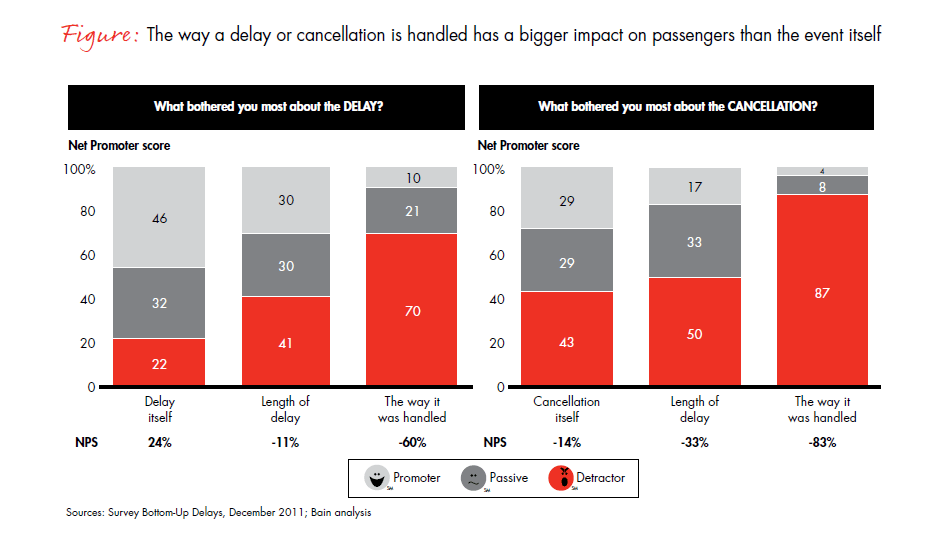
      Closer analysis yielded different insights. How the airline handled delays seemed more important than the delay itself (see figure). In fact, delayed passengers mostly fell into one of two groups: those who felt that the airline’s communication about the delay had been terrific and those who thought it was terrible.
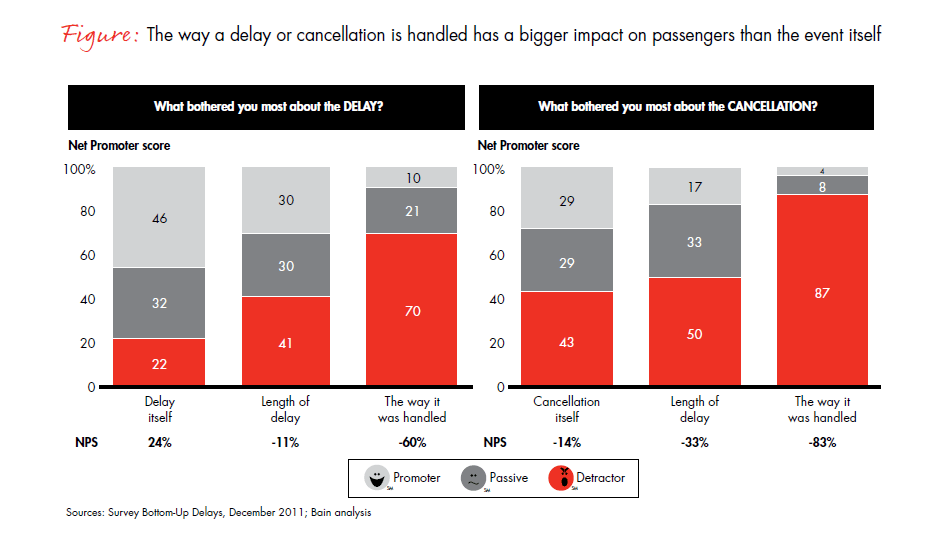

      Passengers who thought the airline had communicated well gave it far higher scores than those who did not. In fact, the scores from passengers who experienced long delays but good communication were about the same as scores from passengers who experienced only minor delays, but thought the communication had been lousy.

      Researchers could now investigate each group further. Why did some people believe that communication had been so good? It turned out that someone in authority, usually the pilot, had addressed them clearly and explicitly about what he or she knew, and had shown empathy with the passengers’ plight. Asking why that didn’t happen all the time, the airline found that its procedures were poorly defined: No one was quite sure who was supposed to address the passengers. Some pilots took the initiative to do so, others did not. Moreover, pilots had differing levels of communications skills. Some made passengers feel a lot better and others did not.

      As for the group that felt communication had been poor, many respondents said they had been given conflicting information, and thus believed that someone had lied to them. Again, researchers asked why. They found that gate agents and other employees were often using different and uncoordinated computer systems, which provided different information. They also discovered that gate agents were reluctant to give out incomplete information—they didn’t want to be perceived as lying—but as a result they waited for “just five more minutes,” over and over. Unfortunately, their good intentions resulted in prolonged silence that contributed to passenger anger.

      Notice what was going on here? The researchers weren’t content with first answers, or even with second and third ones. They keep asking why, in the manner of the famous “Five Whys” of the Toyota Production System. Their goal was to get to the bottom of things—the root cause of customer happiness or discontent—and they finally did. Armed with the root-cause research, the airline was able to take relatively inexpensive corrective actions, such as synchronizing information systems, clarifying communications procedures, and training pilots in communications skills.

      Quick, granular feedback from customers is indispensable to a company, which is why we originally developed the Net Promoter System®. But you must always be certain that you understand what your customers are really telling you before you take action.

      Written by Rob Markey and Fred Reichheld, authors of The Ultimate Question 2.0: How Net Promoter Companies Thrive in a Customer-Driven World. Markey leads the Global Customer Strategy and Marketing practice at Bain & Company and Reichheld is a Fellow at the firm.

      root-cause-of-your-customers-anger-fig_full

      Net Promoter®, Net Promoter System®, Net Promoter Score® and NPS® are registered trademarks of Bain & Company, Inc., Fred Reichheld and Satmetrix Systems, Inc.

      Authors
      • Headshot of Rob Markey
        Rob Markey
        Advisory Partner, Boston
      • Headshot of Fred Reichheld
        Fred Reichheld
        Bain Fellow, Boston
      Contact us
      Customer Interaction Prioritization
      Delta’s Ascent: How a Legacy Airline Earned a Leader’s Spot in Loyalty

      From biometric insights to personalized service recovery, Delta is showing what it means to make emotion a KPI. Learn what’s behind the airline’s NPS surge.

      More
      Customer Interaction Prioritization
      AI in the Air: How Airlines Are Elevating Loyalty Programs

      Airline loyalty programs have been losing altitude as reduced benefits frustrated frequent travelers. Now, airlines are turning to AI to rebuild trust and improve satisfaction.

      More
      Customer Interaction Prioritization
      The Secret to Mars’s Remarkably Durable Success: Customers Come First

      CEO Poul Weihrauch explains how Mars uses both its heart and head to navigate an evolving world with purpose.

      More
      Customer Interaction Prioritization
      How to Know Who Your Best—and Most Valuable—Customers Are

      Many companies have no idea who their best customers are, but new software tools illuminate the critical role promoters play and the value they create.

      More
      Customer Interaction Prioritization
      The Incredible Value of Accurate NPS Data

      Third-party double-blind NPS data like that compiled by NPS Prism enables executives to gauge their customer excellence vs. the competition.

      More
      December 19, 2012
      Tags
      • Customer Interaction Prioritization

      Want to continue the conversation?

      We offer unparalleled analytic and organizational tools for the Net Promoter System. Together, we can create an enduring customer-centric culture.

      Get the latest on loyalty in your inbox. Our quarterly Loyalty Insights newsletter offers our best thinking and tips on running the Net Promoter System.

      *I have read the Privacy Policy and agree to its terms.

      Please read and agree to the Privacy Policy.
      Bain & Company
      Contact us Connect Subscribe Terms of use Privacy Environmental Policy Sustainable Procurement Policy Sitemap

      Net Promoter®, NPS®, NPS Prism®, Net Promoter System®, and the NPS-related emoticons are registered trademarks of Bain & Company, Inc., NICE Systems, Inc., and Fred Reichheld. Net Promoter Score℠ is a service mark of Bain & Company, Inc., NICE Systems, Inc., and Fred Reichheld.