

Forbes.com
This article originally appeared on Forbes.com.
Happiness has been a hot topic in business lately and I’ve been delighted to see such a serious subject get the attention it deserves in the corner office. In the Jeffersonian tradition, the “pursuit of happiness” is considered an inalienable right on par with life and liberty. Yet, until recently, managers here and elsewhere in the world made little effort to rigorously measure or manage happiness.
That was part of the reason I created the Net Promoter Score® (NPS®) nine years ago. When I was considering various names for the new metric, I thought seriously about calling it the Net Happiness Score. We describe NPS as a measure of loyalty, but the overarching objective of the framework is to make people happy—so happy that they recommend a product or company to friends and loved ones so they can benefit from a similar experience.
Of course, I ended up calling it NPS. I decided against NHS as a name because I feared it might sound too corny or whimsical to hard-minded business execs, causing them to overlook the very real connection between how customers feel about their experience with a company and that company’s profitable, sustainable growth.
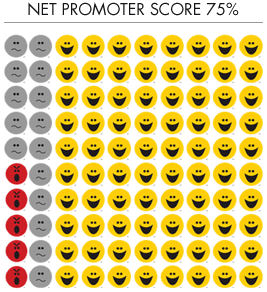
But even today we still maintain a not-so-subtle link between NPS and happiness through the emoticons we use to report the scores. For example, we communicate a Net Promoter Score of 75 with a wall of faces like this:
“If you figure out how to make employees happy and make customers happy, then the business just kind of takes care of itself,” says Zappos CEO Tony Hsieh. “It’s just about delivering happiness.”
Well, it’s not quite that simple since the happiness must deliver profits—but companies already have well-advanced measures to focus efforts on profits. What they have lacked is a rigorous metric for happiness—until the adoption of NPS. Leading practitioners use different language to describe the underlying emotional engine of NPS: Apple talks about enriching lives. Intuit talks about delighting customers. Rackspace talks about “Fanatical Service.” But they are all talking about the same thing: making customers happier.
As I have noted before, in our work at Bain & Company we find it nearly impossible to separate the notions of employee happiness and customer happiness—they are two sides of the same coin. There is no way to consistently turn customers into promoters unless they are being served by employees who are equally enthusiastic about their work, and there’s no way employees can be enthusiastic about their work if the customers they deal with all day long are detractors.
Some leaders assume that simply making employees happy will result in happy customers. That is dangerous thinking. When employees come to believe that the job of their leader is to make them happy, the result is almost always entitled but uninspired employees—who help create fewer and fewer happy customers.
Leaders can and should treat their employees well, but they can’t make them happy. True happiness must be earned through meaningful service to others. When a customer scores an employee’s work a 9—or especially a 10—they are giving a standing ovation that provides a real source of sustainable happiness.
What bosses can do is make sure their people are in a position to earn lots of 10s from their customers—by structuring teams correctly, assigning good leaders, providing the right tools and training, supporting them with good policies and putting individuals in roles that play to their strengths. And, as important as any of these, they can install a system that measures the impact employees have on customers and lets employees hear that feedback in a timely manner.
Many loyalty leading companies install employee NPS feedback systems to work in parallel with their customer NPS systems, because they recognize the close and interconnected relationship between customer and employee happiness. Integrating those two systems isn’t always easy—employee feedback has long been the province of the HR department, and employee NPS drifts naturally in that direction.
But loyalty leaders such as Apple Retail and JetBlue work hard to ensure that employee engagement isn’t pursued independently of the goal of delighting customers. Instead, they ensure that they set up a virtuous circle that positions employees to earn “10s” from customers and to hear about it and are rewarded for it. Employee and customer Net Promoter feedback systems remain fully integrated at those companies, because they are part of the same pursuit—the pursuit of happiness.
Fred Reichheld is a fellow at Bain & Company and co-author, with Rob Markey, of The Ultimate Question 2.0: How Net Promoter Companies Thrive in a Customer-Driven World, published in September by HBR Press.
Net Promoter®, Net Promoter System®, Net Promoter Score® and NPS® are registered trademarks of Bain & Company, Inc., Fred Reichheld and Satmetrix Systems, Inc.

Net Promoter for People
Unleash the energy, enthusiasm and creativity of your workforce to fuel productivity and innovation.
January 25, 2012